Monday, April 27, 2009

Making some money with a blog

1. Maintaining Momentum


According to Technorati’s research, one blog is created every second and that’s 86,400 per day or 31,536,000 per year. That is a huge figure considering that almost half of the planet earthlings are not connected to the internet.


The blogosphere continues to double about every 5.5 months and about 13% of all blogs are updated at least weekly. The main issue is how long does a blogger blogs before giving up? A week? One month? According to Technorati, half of the new blogs become redundant after just three months.

There is a name for these blog - they’re often called splogs or blog junks. Most bloggers started out with a good intention, always with a big picture in their mind. The secret path to success is the ability to continuing blogging consistently. It doesn’t matter if no one drop any comments or someone uses harsh words banging you, the ability to maintain the momentum and chunk out interesting articles is the key to success. Most blogs takes an average of 6 months to built up the much needed momentum to leap frog one to the other stage.


2. Topics


Choosing the right topic is like choosing the right partner, if you choose the wrong topic, especially the one that you’ve got no interest in, chances are you’ll soon end up in a crossroad. I’ve come across bloggers that create blogs that target high paying keywords.


The best topic would be something of your interest, be it music or art that has a niche market in the digital world. If you’re passionate about the topic you are blogging, chances are you will never run out of ideas, remember - maintain the momentum is the key to success.


3. Blogging Platform

There are a few blogging platform to choose from, the current market leaders are Blogger,Wordpress and MoveableType. I would say that these three platform has the lion share in the blogging world. All have their plus and minus points.


Depending on your budget, if you’ve got the money and the desire to blog, then by all means get a paid hosting and host your own blog. The plus point in having your own domain name and hosting server is the ability to get a better ranking in Google Search Engine. Most search engine tend to shy away from free hosting server, even Google rank blogs from their own Blogger.com below others that has their own unique names.


If you are not sure about getting your own paid hosting plans, I would recommend you to try out this reliable hosting company 3iX, its a Singapore based hosting company and you get a 14 day trial. Unlike GoDaddy, you don’t need to be a rocket scientist to install Wordpress, 3iX offers everything with a single click, yup, you can install wordpress with a single click.


4. Diversity of opportunities


Diversifing is the key to success, bloggers that seek a steady flow of income should have multiple blogs that spread accross different server and topics so as not to put all their eggs in one basket. Multiple blogs doesn’t mean one has to stick to a single contextual advertising company, recent years have withness the addition of a variety of viable advertising options for bloggers. Unlike the yer before 2005, adsense and blogads and a handfull of other are the only option available.

Six ways to experiment with AdSense and grow your earnings

Welcome to our first-ever guest blog post on Inside AdSense. We're thrilled to have none other than Blogging Evangelist himself, Darren Rowse, to share his expert tips on AdSense optimisation. 

Darren first discovered blogging in 2002, and initially thought he'd turn it into a hobby to supplement his full-time job. These days, Darren runs a handful of successful blogs, his most popular being Digital Photography School, and has co-authored a book. He also posts regular tips and advice on ProBlogger.net, a respected and successful resource for bloggers around the world.

We recently caught up with Darren at his home office in Melbourne Australia, and asked him about his experience with Google AdSense.


October 4, 2003 is a date I'll never forget - that was a day that my life changed. It was the day that I discovered AdSense and added it to my very first blog. I added that first advertisement to my blog on a whim, with what I thought was the lofty dream that I might be able to pay for my blogs hosting costs. Over 5 years later, those little text ads have paid my mortgage, fed my family, and enabled me to move my blogging from a hobby, to a part time job, to a full time job and beyond.
It's not been an 'overnight success' by any means but as I've learned to use it, AdSense has been one of my highest online income streams. 

My #1 Tip for Using AdSense

If I had to narrow my advice on using AdSense down to a single word it would be 'experiment'. Let me explain. 

That day back in October of 2003 I had no idea on what I was doing. The next day when I logged in to see how much I'd earned it was barely enough to buy me a coffee. 

However, on that day I decided that those few dollars in earnings showed potential and I determined within myself to learn how best to use AdSense to grow that income. Almost everything I've learned since that day has been through trial and error. 

It has been a long process of testing and tracking results. You see, while there are a few good home truths that seem to work on most sites, every website that I've used AdSense on is different. Some things work well on some sites, but it is rare to find something that will work on every site. As a result I tend to experiment with my use of AdSense in these six ways:
  1. Ad Position - Most AdSense publishers have seen the neat little heat map that AdSense has produced to show where ads work best on websites. In general it works fairly well and is a great place to start, but make sure you experiment with new positions for ads and see what works best for your site. 

    Hint: Ads near (or even surrounded by) content have worked the best. I've also found ads at the end of content perform well. People get to the end of reading your article and then are looking for something to do or click -- an ad positioned there can work well.


  2. Numbers of Ads - More ads earn more than less ads... don't they? Unfortunately it isn't always the case. 

    Test different combinations and numbers of ad units on your site. There's usually a 'tipping point' where you hit a ceiling of how many ads your users will accept -- push it too far and you could hurt reader engagement, traffic, and in the long run your earnings. On the flip side of this, don't be afraid to have more than one or two ads on a page, particularly if you have long pages with lots of content.

  3. Ad Design - I can still see the first ads that I first used on my blog back in 2003. I can still see them because they fried their imprints into my retina -- they were so LOUD! 

    I figured that the ads would do best if people noticed them so I went for the most crazy color scheme I could come up with. Over the years I began to experiment with different combinations of ads and found that more subtle or blended ads tended to work best for me. Having said that, you can sometimes blend too much, to the point that the ads become invisible to your reader. So test different colors and designs of ads to see which work best. Use the ad rotating tool that AdSense offer publishers to rotate different designs to work against ad blindness among regular readers.

  4. Ad Sizes - AdSense offers us a range of different ad sizes, so experiment with them all to see which works best. Hint: Some might think that the bigger the ad the better it performs. This is not always true. 

    For example, I found that the 'large rectangle' ad (336 x 280) didn't work as well for me as the smaller 'medium rectangle' ad (300 x 250). It turns out that more advertisers (at least those in my niche) prefer the medium rectangle ad as it's a more standard ad unit size than the larger one. Again, the key is to experiment and see what works best for your site and niche.

  5. Ad Formats - I've found that choosing image and text ads works better than just choosing text ads, but that's not the only choice we get as AdSense publishers. 

    AdSense also allow us to run link units, AdSense for search, etc. I've found that each of these different formats will work differently from site to site. I've had blogs where the link unit ads were the best performing units on the site while on other sites it didn't really perform at all. You'll never know unless you test it!

  6. Which Content Converts? - One of the best advances that AdSense has made in the last year has been the integration between it and Google Analytics. To be honest I'm still digging into the metrics that this opens up, but the insight that this gives has amazing potential to increase earnings. 

    By looking at this data you can see what type of content is converting and what isn't. You can also see what type of traffic is converting and what isn't. For example, I've found that search engine referrals are converting better than traffic from social media sites on one of my blogs. Knowing this is powerful as it tells you what type of ads to serve to what types of traffic, what type of promotion to put effort towards, and what type of content to write more of.
Test Track Test Track....

There are books, blogs, articles, forums, and other kinds of resources available to AdSense publishers to help them learn how to use AdSense better. However, in my experience the best way to learn is to 'do'. Put time aside to try new things and then put more time aside to review what you learn. 

But don't leave it at that. When you learn something -- test it against something else (do some research on A/B split testing to learn how to do this). This continual learning will help you to grow in your own expertise of AdSense and increase your earnings.

Sunday, April 26, 2009

Inside AdSense: Stick 'em up!

Inside AdSense: Stick 'em up!
If you're well versed in webspeak, you're probably familiar with the concept of stickiness -- the quality that entices web users to stick around a given site. Here at AdSense, we're down with the web version of stickiness, but we've got a different kind of adhesive in mind: the kind that lets you take the AdSense logo a-go-go.

That's right, we're talking stickers.

We've printed up a batch of AdSense stickers, and we'd be delighted to send one or two your way, wherever you are in the world. The stickers are designed for laptops, but they'll work just as well for placement on mugs, skateboards, or temporarily on a shirt. (Note: turning a pal into a walking Google ad without their knowledge is not recommended.)


So how do you get one of these glue-backed masterpieces? Easy: send us a self-addressed, stamped envelope with enough postage to return 1 oz of sticker goodness to you from our office in California via standard U.S. mail. (Sorry, we can't help you calculate the postage to your location). Send your envelope, along with a note if you'd like, to:
Google AdSense
c/o Arlene Lee
1600 Amphitheatre Parkway
Mountain View, CA 94043
USA
Supplies are limited, so send your envelope soon! Then you can stick with AdSense wherever you go. (And one last thing to keep in mind: while we're flattered that you might want a whole box, note that we're only able to provide one or two per publisher.)

Inside AdSense: Blogtimize!

Inside AdSense: Blogtimize!
Blogging is near and dear to our hearts here at Inside AdSense. We know you want to get the most out of those posts – but how do you do it? 

1. Choose the right ad formats 

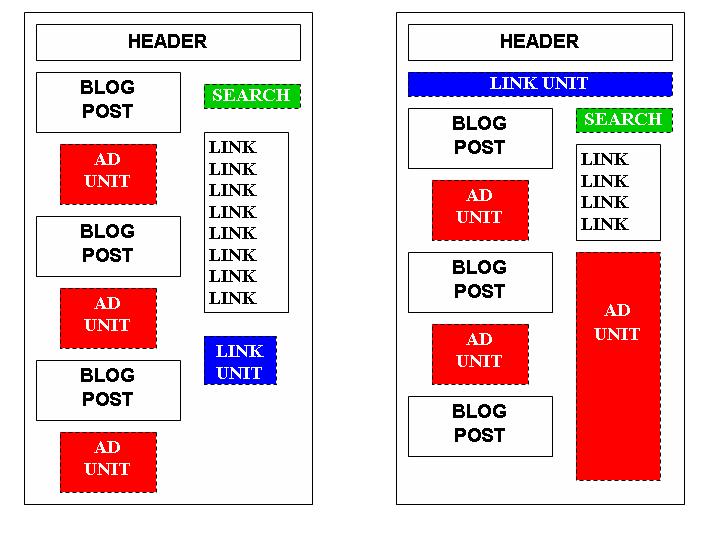
Because the typical blog layout uses a narrow section for posts, the medium rectangle fits nicely at the end of each post. The medium rectangle also supports image ads, increasing the competition and revenue potential for that ad space. For shorter posts, a banner may be a better fit. 

2. Place ads where your readers will notice

Blog main page: 

Whether the subject is gadgets, gossip, or a glimpse into the writer's personal life, readers are deeply engaged with the content of their favorite blogs. What could be more effective than displaying an ad precisely relevant to that content? An ad after each post can serve as a "commercial break" from reading or as an "action step" to take after reading.

Individual blog entries: 

As individual post pages don't have a lot of content, the key is to place ads near your content without bombarding the page with ads. For long entries, try embedding a blended medium rectangle into your post and adding a banner at the end. For short entries, just place one medium rectangle or banner at the end.

If there's a comment section after the post, place a banner or a horizontal link unit just above the comment box. Rather than using the traditional Skyscraper in your sidebar, consider using a link unit, which will offer a wider range of topics and may appear less obtrusive.

3. Improve targeting

How can you ensure that your ads are relevant to a specific post? With section targeting, you can target an ad unit to a specific section of the page, as well as block out irrelevant sections such as the navigational links.

4. Customize your ad colors

For more seamless integration with the content, blend ad units into the background of your blog. Choose a bold color for the ad title to help draw attention to your ads while ensuring that users don't confuse ads with content.


With up to three ad units, one link unit, and one search box on every page, layout options abound! While the suggestions above offer some guidance, you should experiment with different ad unit-link unit-search box combinations on your pages, keeping your particular users' experience in mind when it comes to placement. Most importantly, use custom channels to see what performs most effectively for your site.